
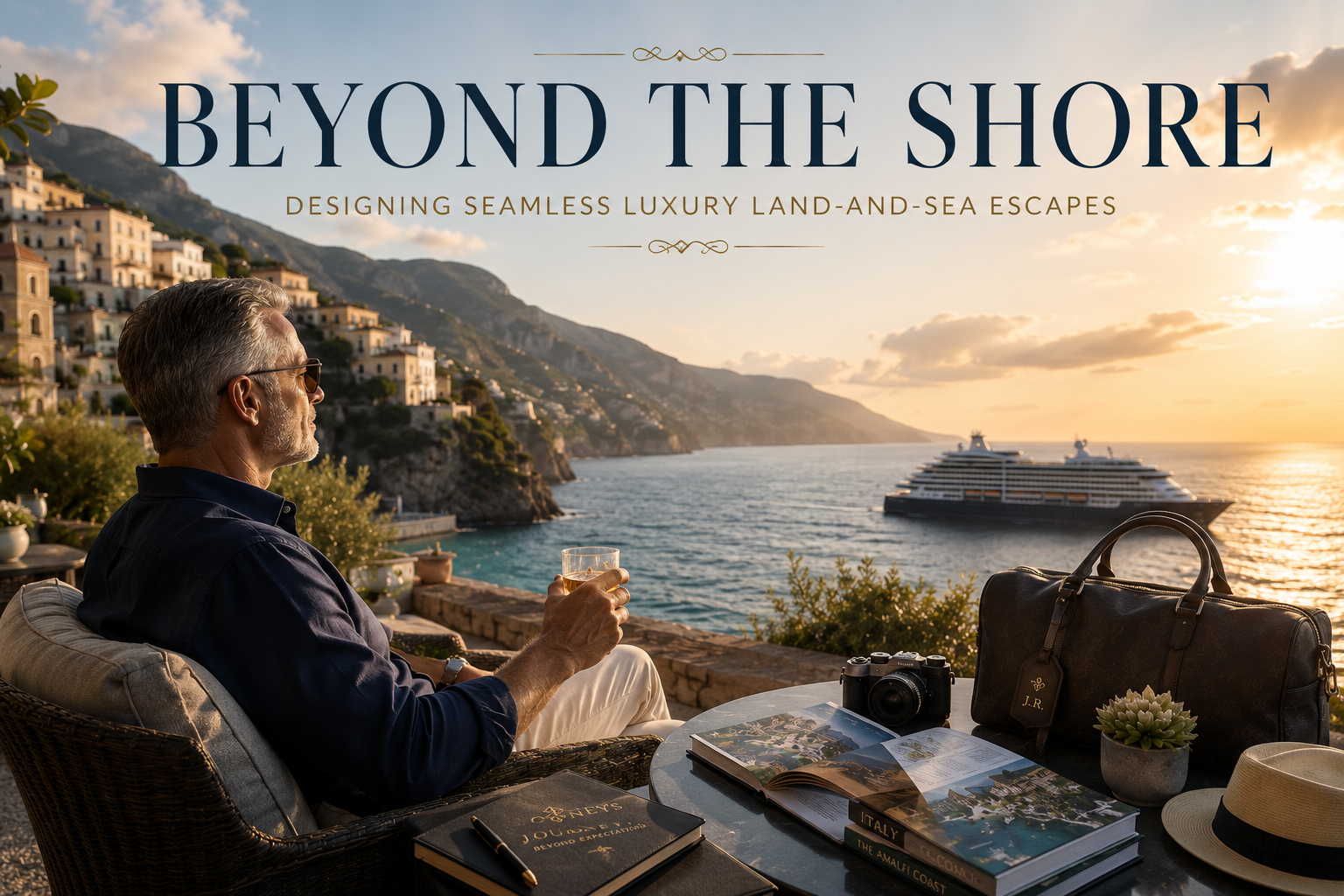
Beyond the Shore: Designing Seamless Luxury Land-and-Sea Escapes
The most extraordinary journeys rarely begin at the gangway. They begin days earlier, perhaps in a centuries-old palazzo in Venice where the light falls differently in the late afternoon, or in a cliffside villa above Gustavia where the Caribbean horizon stretches uninterrupted to the edge of the world. They build through private transfers along coastal roads that tourists in rental cars will never find, through lunches that last three hours because no one has anywhere else to be, through the particular anticipation of knowing that in two days, a ship will appear at the port and the world will expand further still.
This is the land-and-sea escape done properly. Not a cruise with a hotel night bolted onto either end, but a fully designed journey in which the land experience and the sea experience are equals — each one enriching the other, the whole far greater than the sum of its parts.
For travelers who have experienced this kind of itinerary, there is no going back to less.
The Limits of Either/Or Travel
There has long been an artificial division in how luxury travel is discussed and sold: you either take a cruise or you take a land-based holiday. You choose the ship or you choose the resort. This is a false choice, and increasingly, the world’s most discerning travelers know it.
A luxury cruise is extraordinary at what it does: it moves you through multiple destinations with remarkable efficiency while surrounding you with world-class service, dining, and comfort. What it cannot do is linger. A ship must keep its schedule, and while modern ultra-luxury itineraries are designed with more port time than their mass-market counterparts, there are experiences — an extended stay in a single remarkable place, the slow rhythm of a private villa, the ability to spend four nights rather than four hours in a city that deserves more of your attention — that only land travel can provide.
Conversely, a land-based luxury holiday, however beautifully executed, is anchored. You choose a place and you stay in it. The sense of movement, of waking in a new harbor, of watching a coastline you have never seen before appear through the morning mist — that belongs to the sea.
The intelligent answer is not to choose. It is to design an itinerary in which both elements are given their proper space, properly sequenced, and connected without friction.
The Architecture of a Seamless Journey
What separates a genuinely seamless land-and-sea escape from an itinerary that merely contains both elements is design. Thoughtful, deliberate, expert design — the kind that accounts for the pace of each segment, the quality of the transitions between them, and the way each experience prepares and enhances the one that follows.
This is concierge-level travel planning in its truest form. And it begins not with a list of properties or ship schedules, but with a conversation about how you want the journey to feel.
Do you want the land segment to serve as a gentle arrival into the destination’s culture — a few days of immersion before the broader sweep of a cruise itinerary begins? Or would you prefer to end at sea and return to land for a deeper, more leisurely stay in a region the ship has introduced you to? Should the pace be social and exploratory, or quietly restorative? Is there a particular property, city, or experience that has been on the horizon for years and deserves a full chapter of its own?
These questions shape everything. The answers determine which cruise itinerary makes the most natural companion to the land experience, which ports of call create the best thematic continuity, and where the transitions should happen and how they should be handled.
A Mediterranean Journey, Fully Realized
Consider a Mediterranean land-and-sea escape designed without compromise.
It begins in Rome — not with a rushed overnight before embarkation, but with four nights at a historic property in the centro storico, where a private guide meets you each morning and the agenda is yours to shape. The Borghese Gallery with no queue and no clock. A food tour through Testaccio that ends with an invitation into a family kitchen. An evening at a restaurant that does not advertise and does not need to.
On the fifth day, a private transfer carries you south to Civitavecchia — the journey itself unhurried, stopping where it suits you — and you board a Silversea or Regent Seven Seas vessel that will spend the next ten days tracing the coastline of southern Italy, Greece, and the Croatian Adriatic. The ship’s intimate scale means it can anchor in bays that larger vessels cannot reach. The all-inclusive structure means that nothing aboard requires a decision about whether to spend.
The cruise ends in Athens. Rather than a direct flight home, three nights follow at a private retreat on Santorini — because the ship has passed Santorini, and you have seen it from the water, and you have decided that it deserves more than an afternoon. A helicopter transfer from Athens makes the journey to the island in twenty minutes. The villa has a pool that appears to dissolve into the caldera. There is nothing scheduled. That is the entire point.
This is not a complicated itinerary. It is a complete one.
The Caribbean: Where Land and Sea Were Made for Each Other
The Caribbean is, arguably, the natural home of the land-and-sea escape. The region’s islands are close enough together that a cruise moves through multiple cultures and landscapes in a single week, yet distinctive enough that any one of them rewards extended time.
A well-designed Caribbean luxury journey might begin with four nights on St. Barthélemy — the island that has long attracted the kind of traveler for whom discretion and quality are non-negotiable. A private villa above Colombier beach, a water taxi to offshore cays, dinners at Eden Rock or a table arranged through a local connection that does not appear on any booking platform. The island at its own pace, without an agenda.
From St. Barths, a private yacht transfer connects to the embarkation port at St. Maarten, where a Seabourn or Paul Gauguin sailing begins. The itinerary moves south through the Grenadines, St. Lucia, Barbados — islands that the opening land stay has primed you to understand more richly, having already spent time in the rhythm of the Caribbean rather than arriving cold from a long-haul flight.
The voyage ends in Barbados, where rather than flying directly home, two nights at a preferred property on the west coast allow the journey to close at the same unhurried pace at which it began. A final rum punch on a terrace above the water. A morning swim in water warm enough to feel like permission. Then, and only then, the journey home.
Private Transfers: The Overlooked Architecture of Luxury Travel
In conversations about luxury travel, private transfers are almost always an afterthought. They should be among the first things discussed.
The quality of a journey’s transitions determines the quality of the journey itself. The difference between a private vehicle with a knowledgeable local driver who knows to stop at the viewpoint overlooking the bay and a shuttle shared with strangers running twenty minutes late is not a small one. It is the difference between a transition that is part of the experience and a transition that merely interrupts it.
Every movement in a thoughtfully designed land-and-sea escape — airport to hotel, hotel to port, port to villa, villa to helipad — should be handled with the same level of care as the experiences it connects. A luxury travel advisor coordinates these details not as administrative tasks but as integral elements of the journey’s overall texture.
Private seaplane transfers from one Caribbean island to another. A classic wooden boat from the harbor to a hillside property accessible only by water. A vintage car arranged to meet you at the port in Palermo. These are not extravagances for their own sake. They are the connective tissue of an experience that feels genuinely considered at every point.
Pre- and Post-Cruise Experiences: More Than Buffer Time
Among travelers who book land-and-sea itineraries for the first time, the most common regret is not having allocated more time to the land segments. Pre- and post-cruise stays are often treated as buffers — a night or two to account for flight schedules — rather than as destinations in their own right.
The transformation happens when those land segments are given genuine length and proper design. Four nights in Lisbon before a transatlantic crossing, during which a culinary tour of the Alentejo region is arranged as a day excursion. Three nights in Tokyo following a Japan-focused cruise, spent in a traditional ryokan in the Hakone highlands with views of Fuji and a kaiseki dinner that will be the benchmark against which every future meal is measured. A week in the Scottish Highlands after a British Isles sailing, at a castle property with a private ghillie, trout fishing on a loch that has not changed in centuries.
These are not add-ons. They are arguments for why the land portion of the journey matters as much as the sea.
The Cruise Maniac Difference: Designing the Whole Picture
Most travel planning begins with a component — a ship, a hotel, a destination. A seamless land-and-sea escape requires beginning with the whole picture and working inward from there.
This is the approach that defines how Cruise Maniac works. Our advisors do not start with availability and fit you into it. They start with your vision — where you have been, where you want to go, what you want to feel, how much time you have, and what level of involvement you want in the planning process — and design from there.
The result is an itinerary in which every element belongs: the land experience chosen because it deepens or anticipates what the sea will offer, the ship selected because its itinerary and scale match the kind of journey being designed, the transitions handled so smoothly that they never feel like logistics. The whole experience elevated, from the first private transfer to the last morning at sea.
Conclusion: The World Is Larger Than Either Shore or Sea
The travelers who take the greatest journeys are not those who choose the best destinations. They are those who understand how to combine experiences in ways that amplify each other — who know that a week in the Greek islands means more if it has been preceded by four days in Athens, and that four days in Athens lands differently when you know a ship is waiting in Piraeus.
The land-and-sea escape is not a compromise between two types of travel. It is the recognition that both have something irreplaceable to offer, and that with the right design, they can offer it together.
Design Your Journey With Cruise Maniac
There is a version of this trip that is exactly right for you. The right ship. The right properties. The right pace. The right moments, in the right order, connected without a single unnecessary complication.
At Cruise Maniac, designing that journey is what we do. Our luxury travel advisors specialize in building bespoke land-and-sea escapes for travelers who expect every element of the experience to be as exceptional as the destinations themselves.
Reach out to Cruise Maniac today to begin designing your custom luxury escape. The conversation costs nothing. The journey will be worth everything.
Visit cruisemaniacco.com to connect with a specialist and start planning.